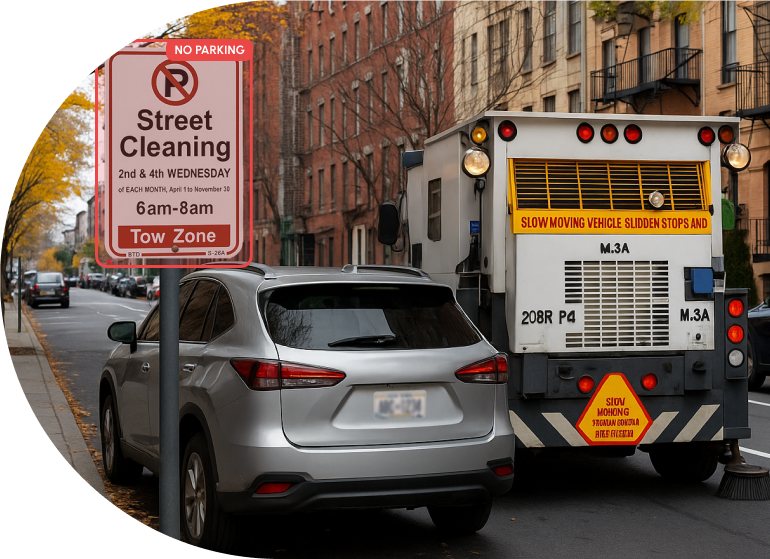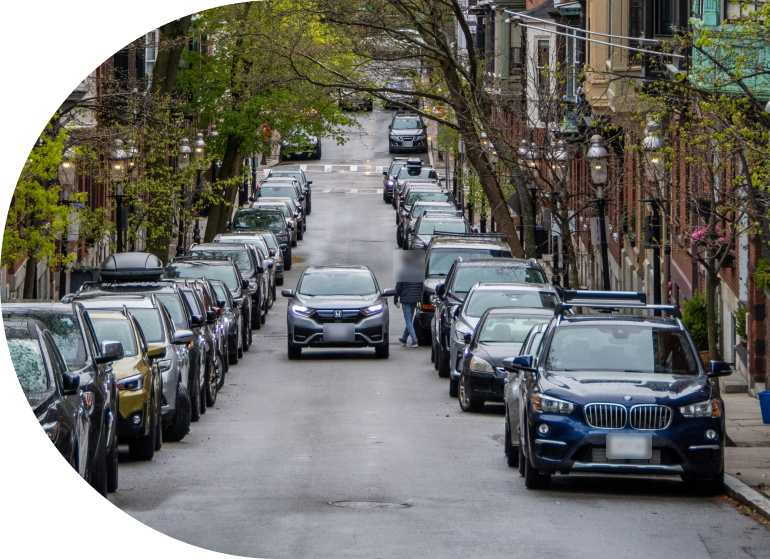
Automated license plate readers and AI-powered license plate readers are not automatically surveillance systems. The distinction depends on why the technology reads a plate, what information it retains, who can access the data, and whether anyone can use it to reconstruct a vehicle's movements.Parking-focused LPR technology has a limited purpose: determine whether a vehicle complies with a specific parking rule. It doesn't need to identify drivers or create a searchable record of their position at a specific moment.

What Is an Automated License Plate Reader?
An automated license plate reader, also called ALPR or LPR, uses cameras and optical character recognition software to convert a license plate image into computer-readable information.
Municipalities use ALPR for parking enforcement, toll collection, traffic management, and public safety. The plate-reading process may be similar, but the systems using LPR technology differ significantly in their purpose, capabilities, and data practices.
That makes the term "ALPR" too broad to explain what a particular camera actually does.
What Is AI LPR and How Does It Work for Parking Enforcement?
AI LPR adds AI capabilities to traditional plate recognition. Instead of simply reading a plate and comparing it with a database, the technology can interpret the surrounding parking context and apply the rules configured for that location.
The purpose is to determine whether a vehicle:
- has paid for parking;
- has a valid digital permit;
- exceeded a posted time limit;
- stopped in a restricted space.
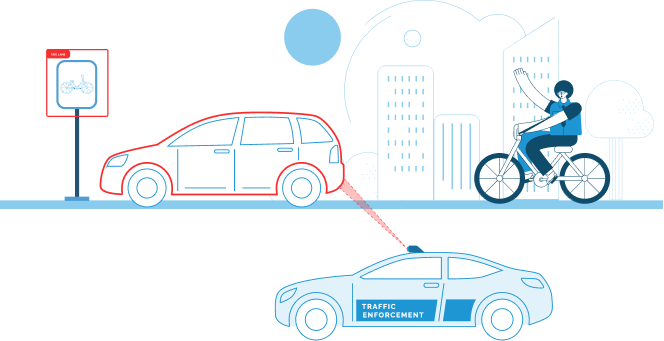
It can also support enforcement around accessible spaces, loading zones, bike lanes, and transit lanes.
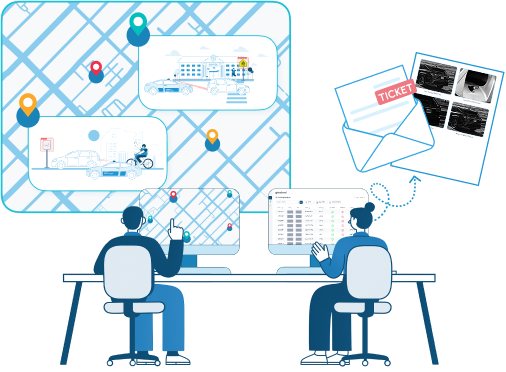
When the system detects a potential violation, it prepares an evidence package for review. An authorized officer examines the information and makes the final decision.
Throughout the workflow, AI supports the officer, but it never issues citations on its own.

Why Municipalities Use AI LPR for Parking Enforcement
AI LPR gives parking enforcement teams a faster and more consistent view of what is happening at the curb. It identifies potential violations as officers move through their routes, which means they can scan more spaces than manual patrols and prepare time-stamped photo evidence for review. This lets officers cover larger areas with existing staff while spending less time stopped roadside or approaching drivers — which also reduces face-to-face confrontations and helps keep officers safe.
This upgrade from manual processes creates a more transparent enforcement process. Decisions rely on consistent rules and documented evidence, reducing the potential for selective enforcement or perceived bias. Drivers can also review the evidence if they question a citation.
Furthermore, AI LPR captures a potential violation when it occurs, so driving away after seeing the enforcement officer approaching no longer makes the parking violation disappear.
All these benefits lead to more consistent parking compliance, safer curb access, and a fairer, more transparent municipal service.
Parking Enforcement vs. Vehicle Surveillance
To understand the difference, look at what happens after the camera reads the plate.
A surveillance-focused system may combine plate reads from many cameras, retain them over time, and allow authorized users to search for a vehicle across locations or jurisdictions.
On the other hand, a parking enforcement system requires only enough information to establish whether a vehicle followed the parking rules at a particular place and time.
Parking enforcement systems don't need to:
- identify the person driving
- analyze people shown in an image
- search for unusual travel patterns
- compare vehicles against general law-enforcement databases
Such capabilities aren't necessary for parking enforcement and management; therefore, they aren't part of SenSen's parking-focused deployment.
However, purpose alone doesn't guarantee privacy. The system's technical configuration, access controls, and retention policies must support the limited use. For example, SenSen developed its AI LPR technology specifically for parking enforcement and curb management. It detects only the parking conditions the municipality configures, keeping the technology focused on a defined municipal task. No one can come in a second moment and force a different destination for the data because the system didn't collect the information in the first place.
AI LPR Data Retention, Ownership, and Control
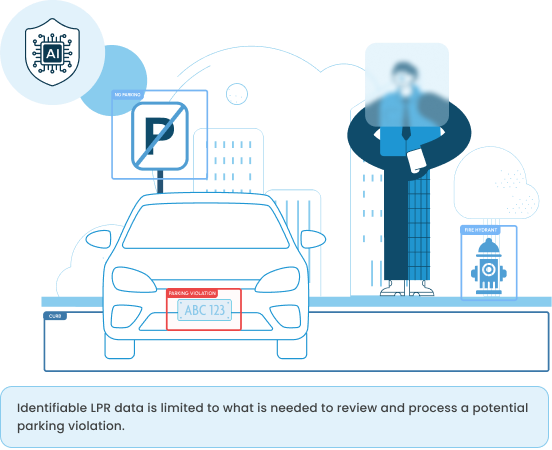
A privacy-focused parking enforcement program limits identifiable LPR data to what is needed to review and process a potential parking violation.
The system must automatically blurr faces and pedestrians and mask the plates associated with compliant vehicles. Evidence connected to a potential violation may remain available until the citation, payment, or appeal process is complete. Depending on local regulations, municipalities may delete this data as soon as 24 hours after the case is resolved.
It's in citizens' best interest for each municipality to own and control its data under local retention policies. Authorities must also limit data access to authorized users only so that information remains in a private environment rather than being pooled across agencies, added to an external network, or repurposed by the vendor.
Current Automated License Plate Reader Legislation
Across the US, automated license plate reader laws form a growing patchwork of state rules. Current statutes and proposals also take different approaches. Some regulate how ALPR technology may be used and recognize parking enforcement as a distinct, authorized purpose. Others apply broad restrictions to nearly every system capable of reading a license plate.
Some of the current legislation shows that communities do not have to choose between valuable public services and protecting privacy. Laws can authorize clearly defined uses, such as parking enforcement and curb management, while placing firm limits on data collection, retention, ownership, access, and sharing.
Washington recognizes parking enforcement as an authorized use
Washington's Driver Privacy Act (signed into law on March 30, 2026) explicitly allows parking agencies and their contractors to use ALPR systems to enforce parking-space restrictions. It also gives public agencies operating the systems ownership of the collected data.
The law limits access and sharing, prohibits unrelated uses, and requires vendors to provide technical controls that prevent unauthorized access. Data retained for parking enforcement must be deleted no later than 12 hours after the final resolution of the case, including any appeal.
Pennsylvania is drawing a similar distinction.
Pennsylvania House Bill 2771 has recently passed the state House (it hasn't become law at the time of writing).
The House-passed language lists parking enforcement as an authorized use of ALPR technology. It also establishes limits covering access, disclosure, and retention. Information needed to assess or collect a parking fee may remain available for that purpose. Other captured data would generally face a much shorter retention period.
Broad Federal Proposals May Affect Parking Systems
The federal NO FLOCK Act, introduced on September 14, 2026, would withhold 10% of certain transportation funding from states that permit ALPR uses beyond toll enforcement and a limited group of public safety cases.
The introduced text does not provide a parking enforcement exception.
The language defines captured plate data broadly enough to include information produced by parking systems and commercial parking operators. It provides a detailed exception for toll collection but no equivalent general exception for municipal parking enforcement. The bill remains a proposal, not current law.
These proposals respond to legitimate privacy concerns. However, legislation based primarily on the presence of plate-reading technology could restrict systems that cannot even perform the activities lawmakers want to prevent.
AI LPR Privacy FAQs
Are automated license plate readers considered surveillance?
It depends on how the system operates. An LPR system that retains observations from many locations and allows users to search a vehicle's movements can function as surveillance. On the other hand, a purpose-limited parking system restricts how the resulting data can be used, so surveillance becomes impossible.
Does parking enforcement AI LPR use facial recognition?
SenSen's parking enforcement system does not use facial recognition. It blurs faces and pedestrians and does not identify the driver.
Can municipalities share parking data with other agencies?
SenSen does not pool or share parking data across agencies. It remains within the municipality's private environment and under its control.
How long is parking AI LPR data retained?
Retention depends on the municipality's policy, legal requirements, and the status of the enforcement case. Information connected to a potential violation may need to remain available through review, payment, and appeal. Data that does not serve an enforcement purpose can be masked or deleted sooner.
Can parking AI LPR track where someone has been?
Not by default. SenSen's system evaluates parking compliance within the program area. It doesn't create cross-jurisdictional movement histories or connect to a shared national database. That's because technical controls and municipal policies prevent broader use.