
.svg)


De nombreuses discussions sur la reconnaissance des plaques d'immatriculation assistée par l'IA (AI LPR) portent d'abord sur la répression. Cette technologie aidera-t-elle les agents à repérer davantage d'infractions au stationnement ? Permettra-t-elle d'améliorer la productivité ? Entraînera-t-elle une augmentation des recettes de stationnement suffisamment rapide pour justifier l'investissement ?
Ce sont là des questions importantes, mais elles ne reflètent qu'une partie de la réalité.
La plus grande valeur à long terme de l'investissement d'une ville dans la technologie de reconnaissance automatique des plaques d'immatriculation (LPR) basée sur l'IA réside dans les données opérationnelles qu'elle recueille chaque jour. Ces données aident les décideurs à comprendre comment l'espace de stationnement en bordure de trottoir est réellement utilisé, à remplacer les hypothèses par des faits avérés et à prendre de meilleures décisions bien après le déploiement de la technologie.
Quelles données le système de reconnaissance de plaques d'immatriculation par IA peut-il collecter ?
Au cours de ses patrouilles dans la commune, chaque véhicule de contrôle constate la présence de places occupées, de places libres, de sessions payantes, de véhicules non payants, d’activités liées aux autorisations de stationnement, de zones de chargement, de places réservées aux personnes à mobilité réduite, de fermetures de trottoirs, de restrictions temporaires et bien plus encore.
Ces observations peuvent désormais être facilement transformées en données opérationnelles structurées afin de mieux comprendre les performances des bordures de trottoir de chaque ville.
Selon le programme de contrôle, chaque observation peut inclure :
- Lecture de la plaque d'immatriculation
- Horodatage
- Coordonnées GPS
- Zone de stationnement
- Règles de stationnement applicables
- Statut d'occupation
- État du paiement
- Statut du permis
- Preuves photographiques
En règle générale, la quasi-totalité de ces informations disparaît. Seule la référence est conservée. Tout le reste est perdu : c’est comme si l’on terminait un puzzle pour ensuite jeter toutes les pièces, à l’exception de celle du centre. Il reste certes une partie de l’image, mais on a perdu le contexte qui lui donne tout son sens.
.png)
Si ces informations sont si précieuses, pourquoi n'ont-elles pas été utilisées auparavant ?
Tout simplement parce qu'il n'était pas envisageable de le collecter à grande échelle.
Examinons les chiffres. À Pittsburgh, par exemple, un seul véhicule équipé d'un système de reconnaissance automatique des plaques d'immatriculation (LPR) basé sur l'IA, ayant fonctionné pendant seulement 130 jours d'activité, a permis de collecter :
- Plus de 68 000 observations en bordure de trottoir
- Plus de 50 000 lectures de véhicules distincts
- Données relatives à 957 zones de stationnement
Les agents de contrôle du stationnement ont toujours eu une vue d'ensemble de la situation, mais répertorier à grande échelle l'état de chaque bordure de trottoir aurait nécessité un travail manuel colossal. C'est pourquoi, par le passé, la solution la plus simple consistait à faire de la contravention le document officiel et à ne pas tenir compte de milliers d'autres détails.
La technologie de reconnaissance des plaques d'immatriculation (LPR) basée sur l'IA change la donne. Nous disposons désormais d'une technologie capable de collecter et d'organiser automatiquement les informations que les véhicules des forces de l'ordre perçoivent déjà au quotidien, transformant ainsi les patrouilles de routine en une source continue de renseignements opérationnels.

Comment le système de reconnaissance des plaques d'immatriculation par IA collecte-t-il les données ?
Le véhicule de contrôle suit simplement son itinéraire de patrouille habituel. Au fur et à mesure de son déplacement, les caméras embarquées enregistrent les observations et les analysent en tenant compte du contexte grâce au GPS, aux zones de stationnement et à des règles prédéfinies.
Il est important de souligner que l'IA ne prend pas seule les décisions en matière de contrôle. Des agents qualifiés examinent les infractions potentielles avant qu'une contravention ne soit émise, garantissant ainsi qu'une intervention de contrôle fasse toujours l'objet d'un contrôle humain.
Les informations opérationnelles sont stockées en toute sécurité grâce à des mesures de sécurité adaptées, tandis que les données utilisées à des fins de planification et d'analyse opérationnelle peuvent être anonymisées afin de protéger la vie privée des individus. Les communes obtiennent ainsi des informations précieuses sur l'activité de stationnement sans compromettre la confiance des communautés qu'elles servent.
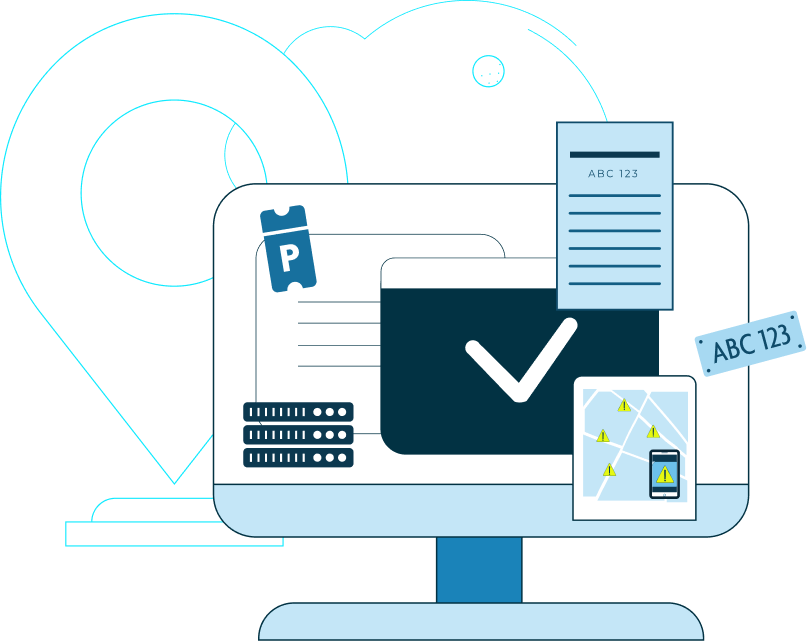
Transformer les observations en améliorations opérationnelles
Une fois toutes ces données collectées, il est temps de les mettre à profit. Et le plus intéressant, c’est que vous avez déjà payé pour les collecter : ainsi, chaque décision que vous améliorez et chaque investissement futur que vous justifiez augmentent le retour sur cet investissement initial.
La valeur ajoutée va bien au-delà du service chargé du stationnement. Une vision opérationnelle continue peut faciliter la planification, la gestion de la mobilité, les finances, les travaux publics et le développement économique, en permettant à plusieurs équipes d’accéder à une même vision fiable de l’utilisation des places de stationnement en bordure de trottoir. À terme, ces informations contribuent à optimiser les ressources, à renforcer les analyses de rentabilité futures et à identifier des opportunités qui, sans cela, resteraient cachées.
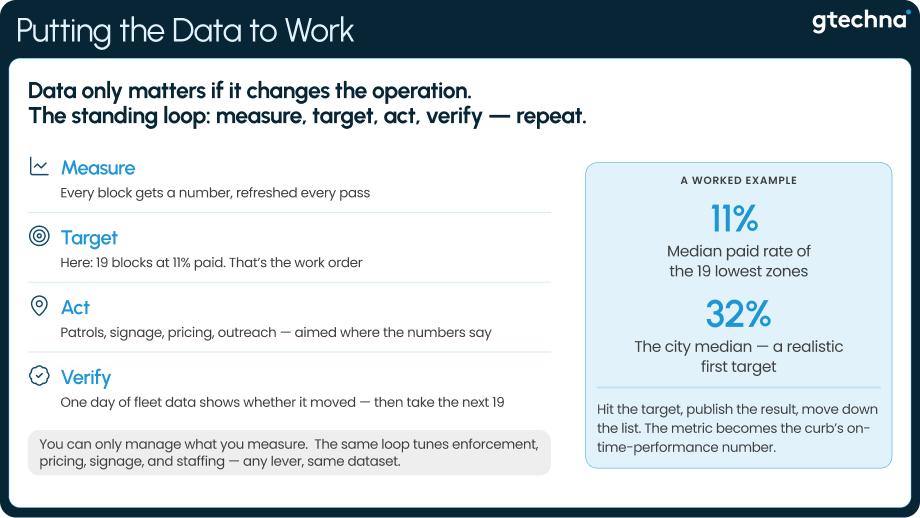
Et surtout, cela n'implique pas la mise en place d'un nouveau processus que votre personnel devra gérer. Le système est conçu pour favoriser l'amélioration opérationnelle dans le cadre des activités quotidiennes de contrôle, grâce à un cycle simple et continu :
- Saisie → Recueillir les observations effectuées en bordure de chaussée lors des patrouilles de routine.
- Analyser → Transformer des millions d'observations en informations opérationnelles pertinentes.
- Établir des priorités → Identifier les lieux et les problèmes qui auront le plus grand impact.
- Optimiser → Adapter l'application de la réglementation, la signalisation, la tarification, les politiques ou l'affectation des ressources en s'appuyant sur des données factuelles.
- Répéter → Chaque patrouille génère de nouvelles données, ce qui permet aux communes de mesurer les résultats et de s'améliorer en permanence au fil du temps.
Pittsburgh illustre bien cette approche dans la pratique.
Après avoir recueilli des dizaines de milliers d'observations sur les places de stationnement en bordure de trottoir, la ville a identifié un ensemble de pâtés de maisons présentant des taux de paiement systématiquement faibles. Plutôt que d'appliquer la même stratégie partout, les données ont permis de cibler les emplacements où une amélioration aurait le plus grand impact.
La ville a testé des changements ciblés dans un quartier, a évalué les résultats à l'aide des séries suivantes de données opérationnelles et, une fois que cette approche s'est avérée efficace, l'a étendue à d'autres quartiers. Au lieu de se fonder sur des hypothèses ou des moyennes à l'échelle de la ville, chaque décision s'est appuyée sur des données mesurables recueillies lors des contrôles quotidiens.
Que se passe-t-il lorsque chaque patrouille devient une mission de collecte de données ?
Une meilleure visibilité permet de prendre de meilleures décisions.
Les données en continu remettent en question les hypothèses, car elles révèlent l'évolution de la demande tout au long de la journée. Vous pouvez également observer en temps réel comment les habitudes de stationnement varient au fil des saisons, et quels problèmes persistent aux mêmes endroits.
Dès lors que ces tendances apparaissent, elles deviennent mesurables. Et dès lors qu'elles sont mesurables, elles peuvent être gérées.
De plus, un seul investissement profite à plusieurs divisions, car tout le monde tire profit d'une meilleure compréhension du fonctionnement du trottoir :
- Les services d'urbanisme disposent d'informations plus précises sur le taux d'occupation.
- Les équipes chargées de la mobilité comprennent mieux comment l'espace le long des trottoirs est utilisé.
- Le service financier dispose d'informations plus précises sur les habitudes de paiement.
- Les équipes chargées du développement économique peuvent ainsi mieux cerner la demande en matière de stationnement aux abords des zones commerciales.
- Les services des travaux publics bénéficient d'une meilleure visibilité sur l'état des bordures de trottoir et les restrictions temporaires.
.png)
Des données plus fiables permettent d'élaborer des analyses de rentabilité plus solides
Les données opérationnelles en temps réel aident également les communes à prendre de meilleures décisions à long terme.
Que l'objectif soit de développer la reconnaissance automatique des plaques d'immatriculation par IA, de mettre à jour les règles de stationnement, de mettre en place de nouveaux programmes de permis ou de solliciter des financements pour de futures initiatives, chaque proposition doit s'appuyer sur des données probantes.
Les données en continu permettent de répondre aux questions qui déterminent l'avenir de votre programme de stationnement.
- Quels sont les secteurs qui connaissent systématiquement une forte demande ?
- Les délais actuellement en vigueur sont-ils toujours adaptés ?
- Quelles sont les zones de permis sous-utilisées ?
- Dans quelles zones de chargement les infractions sont-elles fréquentes ?
- Les moyens consacrés à la répression sont-ils mobilisés là où ils auront le plus d'impact ?
- Quels actifs de stationnement pourraient afficher de meilleurs résultats ?
Au lieu de dire qu'un quartier pourrait nécessiter davantage d'attention, vous pouvez désormais montrer précisément ce qui s'y passe et pourquoi il est nécessaire d'agir. Ces données viennent étayer l'argumentaire.
Des données précises contribuent à améliorer la vie en communauté
La reconnaissance automatique des plaques d'immatriculation (LPR) basée sur l'IA ne se limite plus au stationnement. En facilitant la prise de décision au niveau des places de stationnement, son rôle a des répercussions sur la fluidité du trafic, les commerces locaux, l'accessibilité, la sécurité publique et le quotidien des habitants et des visiteurs.
C'est pourquoi il est essentiel de disposer de données précises.
Lorsque vous disposez de données concrètes sur l'utilisation réelle du trottoir, vous pouvez investir en toute confiance, donner la priorité aux bons projets et mettre en œuvre des changements ciblés, plutôt que de vous en remettre à la méthode des essais et des erreurs.
Votre ville affecte ses ressources là où elles auront le plus d'impact. Vous pouvez affiner vos politiques en vous appuyant sur des résultats mesurables et valider rapidement les améliorations, plutôt que d'attendre des mois avant la publication de la prochaine étude.
Vos décisions apportent des solutions à des problèmes concrets, car elles reposent sur des données factuelles et non sur des hypothèses. Certes, vous avez mis en place un programme de contrôle plus efficace. Mais vous avez également amélioré la qualité de vie dans une ville qui fonctionne mieux, avec des rues plus faciles à parcourir et un stationnement plus équitable et plus prévisible. Vous facilitez l'accès aux commerces, aux véhicules de livraison, aux habitants et aux visiteurs.
-min.png)

